Road to Nowhere

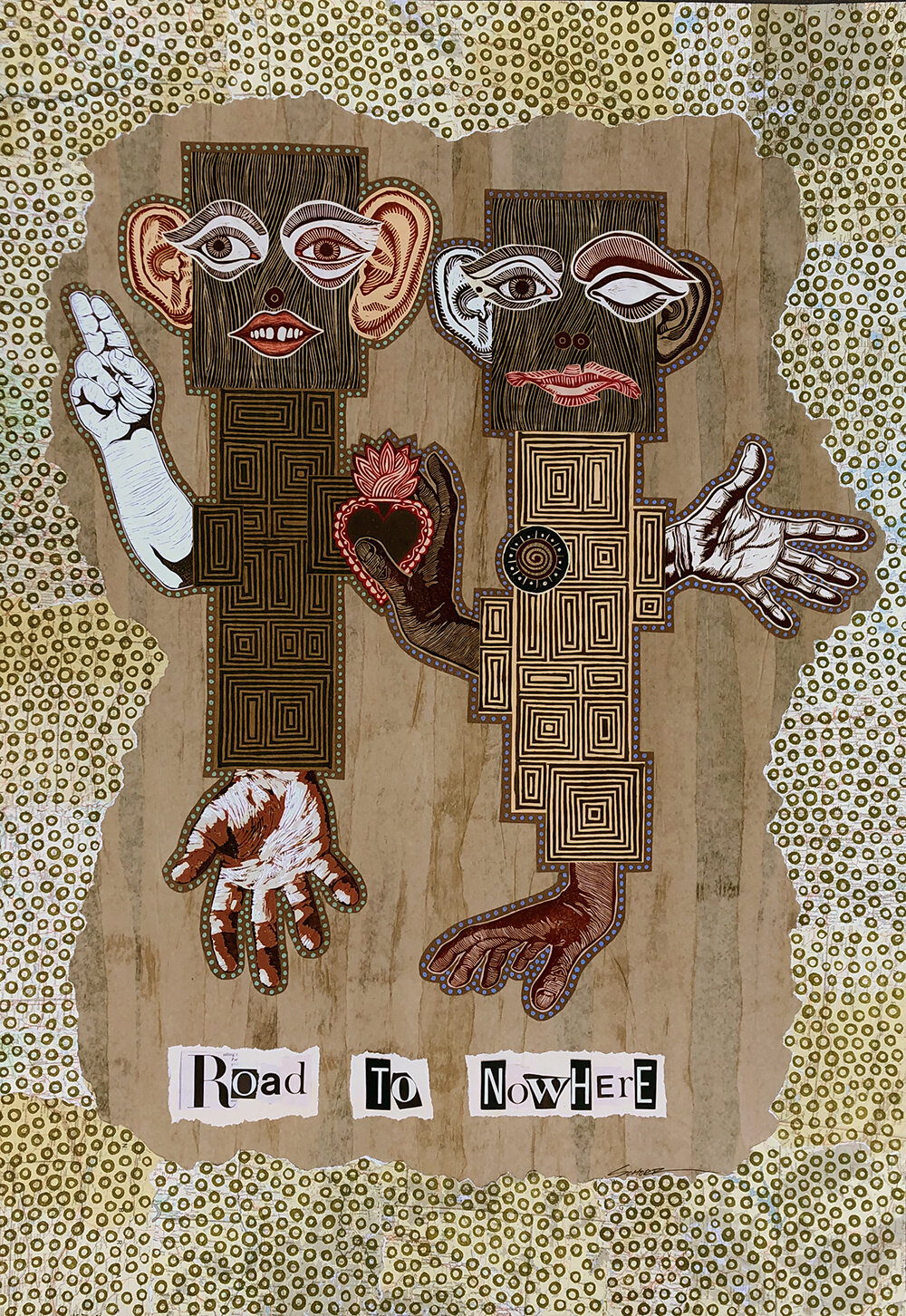
I’m sure I’m not the only person that feels like they are on a road to nowhere. Especially now, because you know, Covid and all. I suppose this piece is more about the “and all” part of my life. Nevertheless, I am pressing forward each day.
Road to Nowhere

Road to Nowhere

I am working like a fiend, which passes the time, and I am on a sabbatical from the news because I’ve had too many 3 AM panic attacks. I never in a million years thought my country would become the corrupt nightmare that it is today. It’s simply horrifying. Another road to nowhere.

I am also applying to several residencies, thinking that going somewhere, anywhere, could only help. There are some really wonderful options out there, but it would seem like getting one is a little remote. However, I don’t suppose someone is going to knock on my door with a bunch of balloons and offer me a residency without my actually applying, so I’m applying to the best ones I can find.

So, Road to Nowhere. A lot of linocuts, including the relief printed background / border, which is printed on old map pages from a vintage atlas I picked up at Goodwill.

Learn more about this piece at its gallery page
A Linocut with New Collage Images

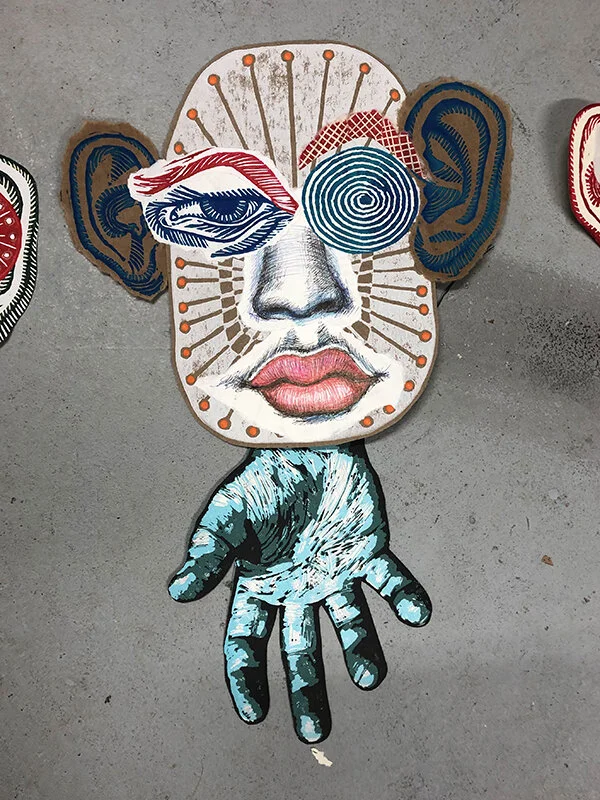
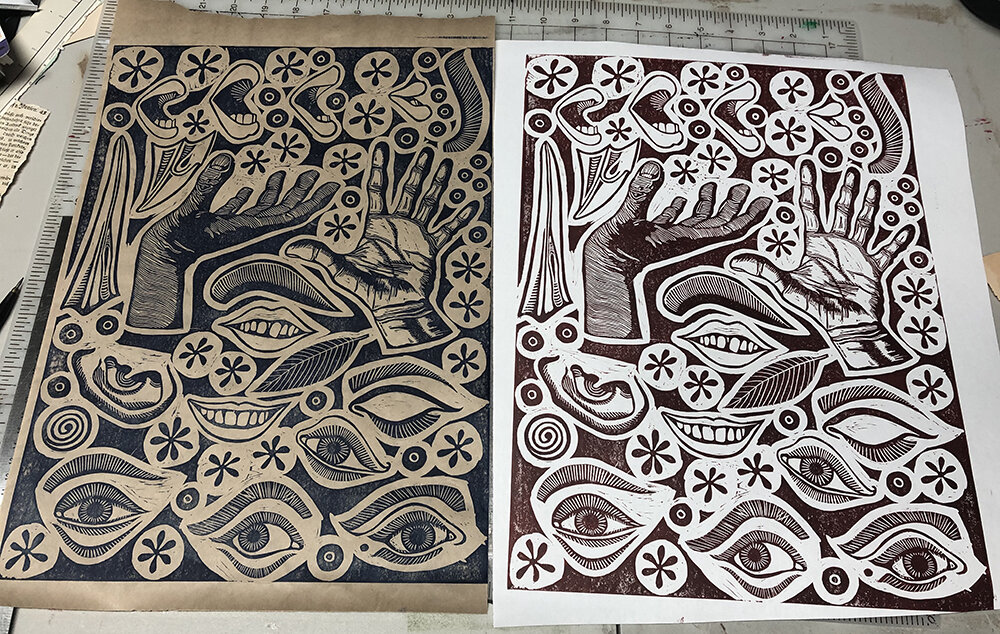
Prints in dark blue and rust red of linocut collage elements

Prints in dark blue and rust red of linocut collage elements

I really wanted some new collage elements, so I did this rather elaborate plate with lots of different elements to add to my growing collection of linocut body parts and backgrounds. There are hands, mouths, flowers, dots, beaks, oversized eyebrows, an ear and a leaf. I’m pleased because I can print up a bunch of things at once, although it takes a larger sheet of paper and it’s a nightmare to cut out.

Song to the Sanguine Moon

Song to the Sanguine Moon

While I am very early in the process of developing a library of interchangeable parts, each new piece gets some old and some new elements

The Sanguine Moon

I used several elements from this plate in this piece, Song to the Sanguine Moon. I added background elements from other linocut plates, along with colored pencils and markers.

The Sanguine Moon is a full moon in October. Sanguine, in its literal translation, means blood red, and there are many wonderful drawings by old masters in sanguine chalk, which is actually more of a terracotta shade than blood red.

I really like all the names of the full moons. There are scads of them, bringing up all kinds of possibilities. I’m not sure which one will be next.

What's New in the Studio - July 31, 2020

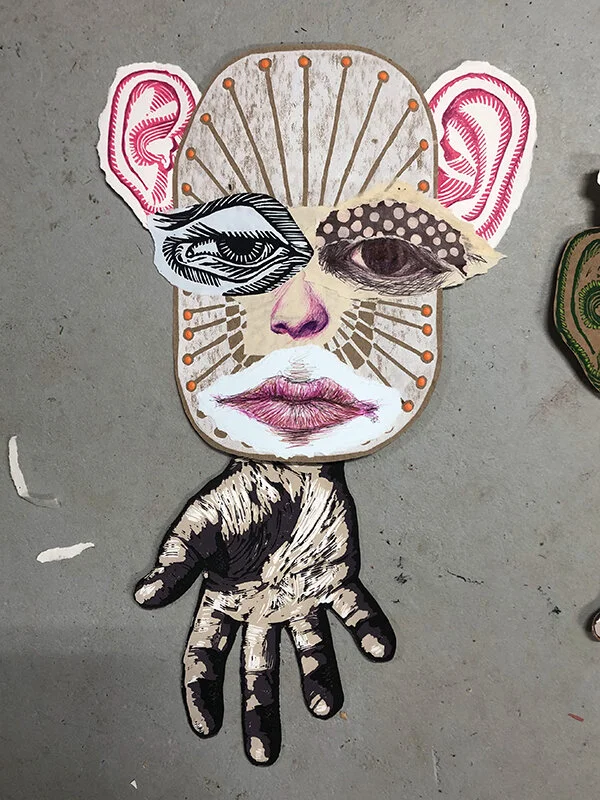
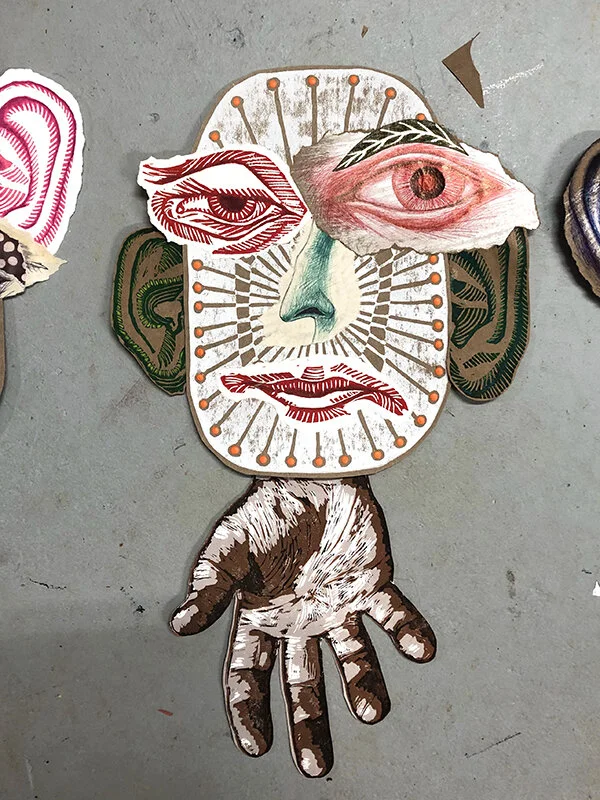
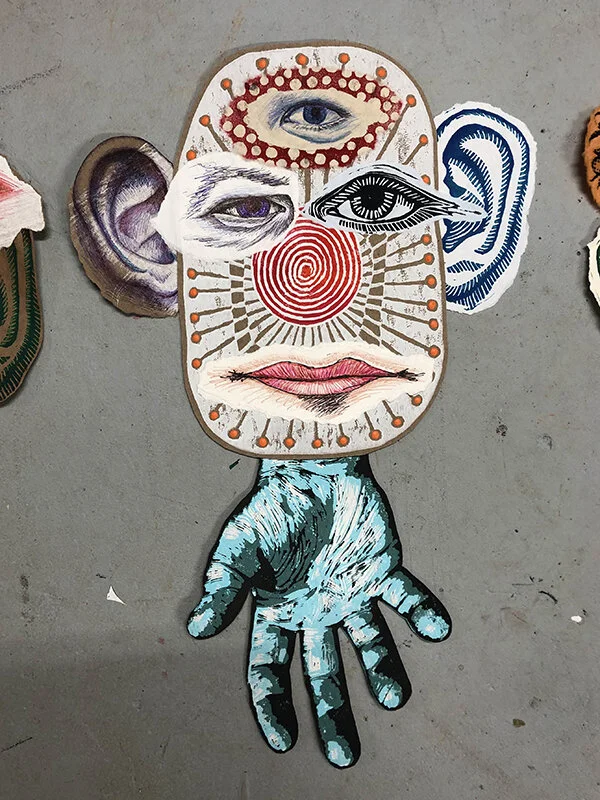
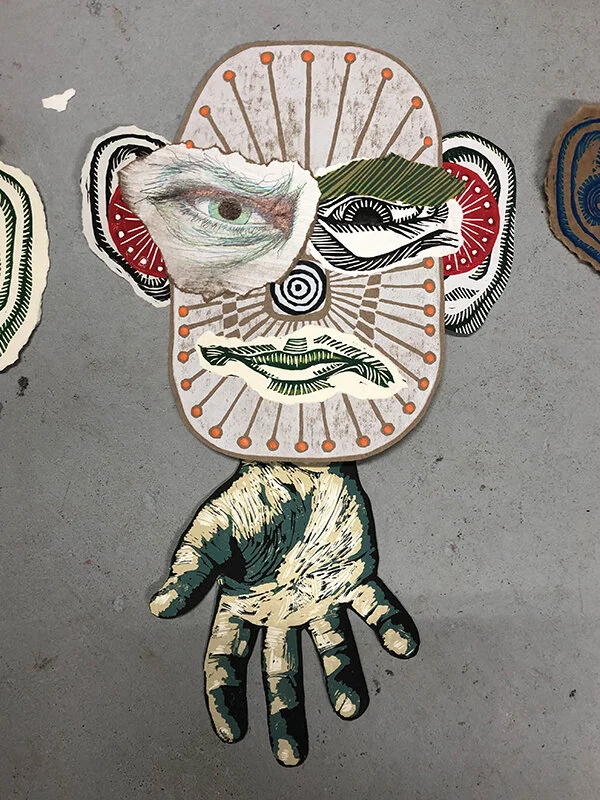
Days of the Week Faces

I was always fascinated by the idea of “Days of the Week Panties.” I don’t remember for sure, but I’m pretty confident that I never had a set. Nowadays, it would be more likely to be “days of the week masks,” which is kind of what’s going on here. Who are we on Monday, and are we different on Friday? I suspect we are.

I’ve been playing with these all week, printing parts and drawing parts. Working out my penitent Sunday and my Wednesday “hump day,” and the subtleties that make up the days in between. I’m not entirely sure about the linear layout or how it will all finish out, so stay tuned.

We all like to think we are more unique than we actually are.

Learn more about this piece on its gallery page.

What's New In The Studio - July 19, 2020

Passionflowers and Leaves

Having finished my leaves linocut block, I printed it a bunch of times on a variety of papers. I get these papers in rolls that are discarded from a local manufacturer, and most of them are just white in a variety of weights and finishes, but occasionally they toss out some more interesting textures and colors, so I used a lot of those items along with various papers I have piled around the studio, many of which are probably not archival but I like them anyway.

I also carved and printed a relief plate with three different versions of a passionflower, and printed that up as well. I cut all this stuff out and arranged and rearranged until I go the body shape I wanted for the woman in my next piece. Then I carefully tacked her together with glue and added some stronger pieces to the back to keep her together. I am putting her in a large mandorla which I will construct next.

A Linocut Buffet of Foliage and Body Parts

Soft linoleum block with body parts Natalie Schorr - 2020

Soft linoleum block with body parts
Natalie Schorr - 2020

I am working on some mixed media collage pieces that use mostly elements I have made, as opposed to elements I have found. Not that one is better than another, I guess they just express my current state of thinking more accurately. In doing this, I have gathered together several old relief cut blocks and started creating some new linocuts of body parts and other elements that may be useful over and over.

These body pieces are proving to be very inspirational for me. I picked up this soft cut linoleum block from Dick Blick. It’s fairly thick, so I carved both sides. The opposite side is carved mostly with manicules. I printed them up in an array of colors, and I’ll use them over and over.

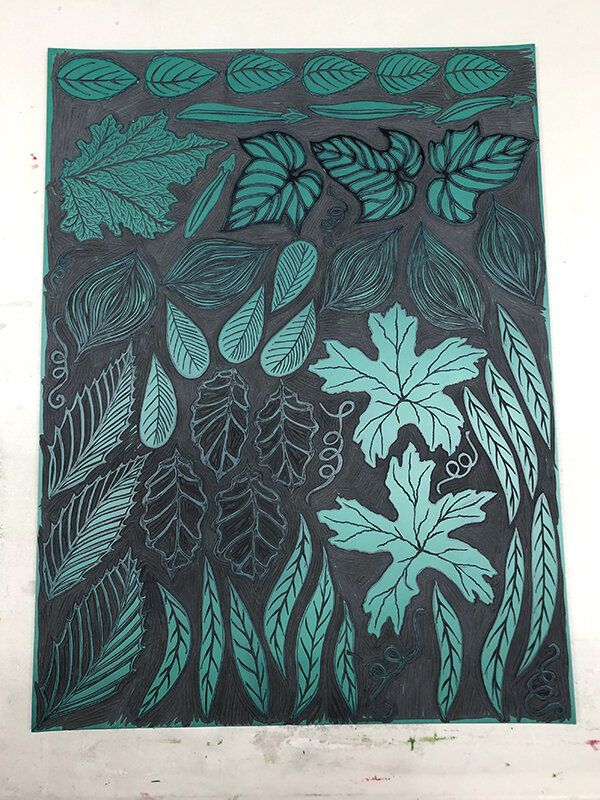
This weekend I also carved up a large lino plate with just leaves. They are another element I can see using a lot, so I drew out a bunch of different shapes. I hope to start printing with these later

Linocut block with leaf shapes Natalie Schorr - 2020

Linocut block with leaf shapes
Natalie Schorr - 2020

I think you will see these leaves and body parts a lot in the coming months.

Telling a Story with Original Prints

I admire my friends who do plein air. They go out and just spontaneously paint. There is very little about a drypoint print that could be considered spontaneous. That being said, it doesn’t have to be a means to a cold, black and white end.

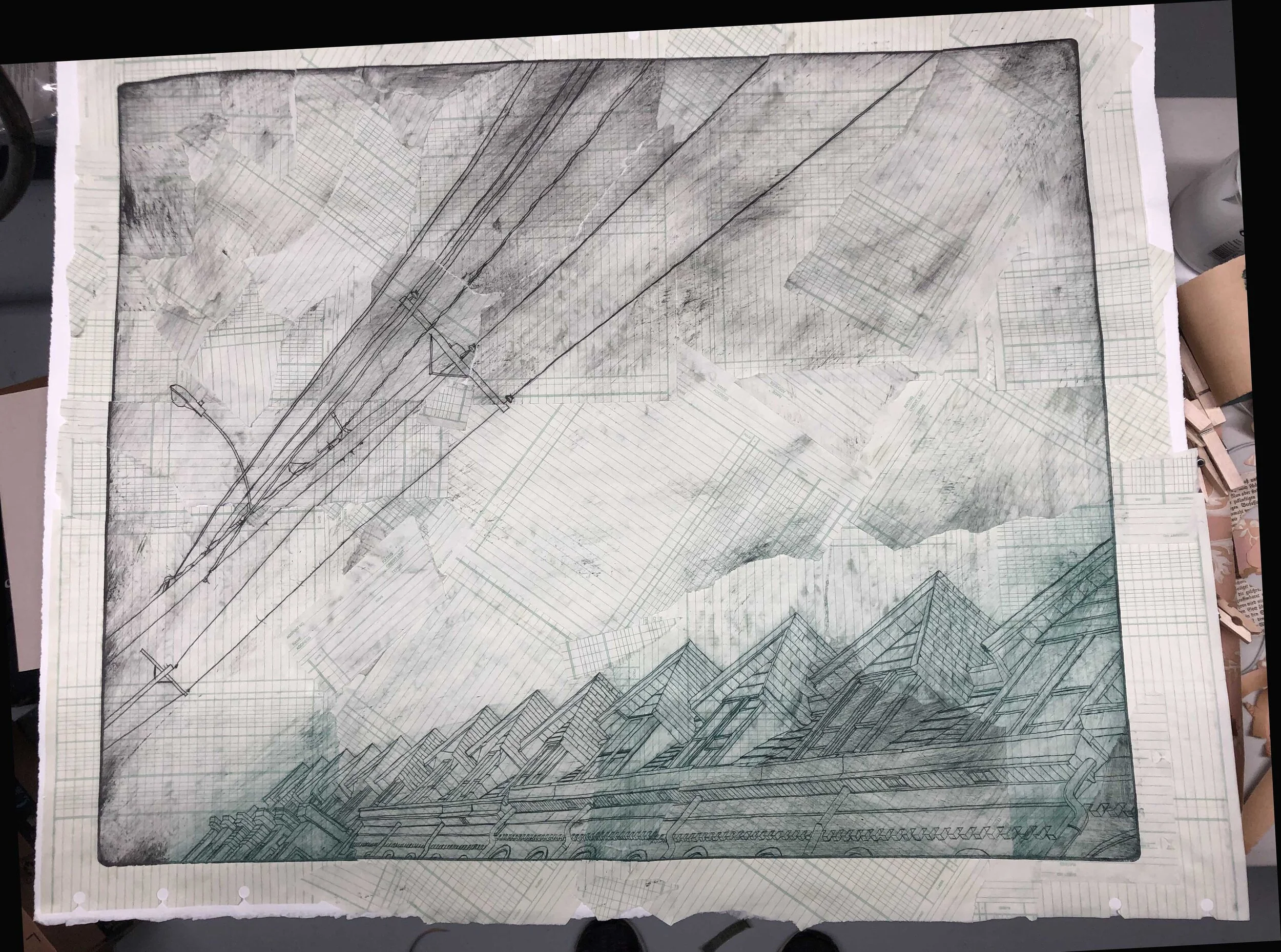
Leaning Rowhouses [green]

Leaning Rowhouses [green]

I did a residency at Remarque New Grounds Print Workshop in Albuquerque in February 2019. I had my drypoint plates already done since they were large and took days to etch, and when I got there I printed like a fiend, which I think drove my whole cohort crazy. Then I shipped everything home and thought about it for several months.

When I first tried my hand at printmaking, I took a little six week class in traditional etching, and we were taught to make multiples that needed to look as much alike as possible. Boring. So in the years since, I have looked for new ways to approach printmaking that would be more flexible. Not quite plein air, but certainly not a series of pieces all just alike.

I like to think of printmaking as a way to tell a story with a different ending each time. Let me show you.

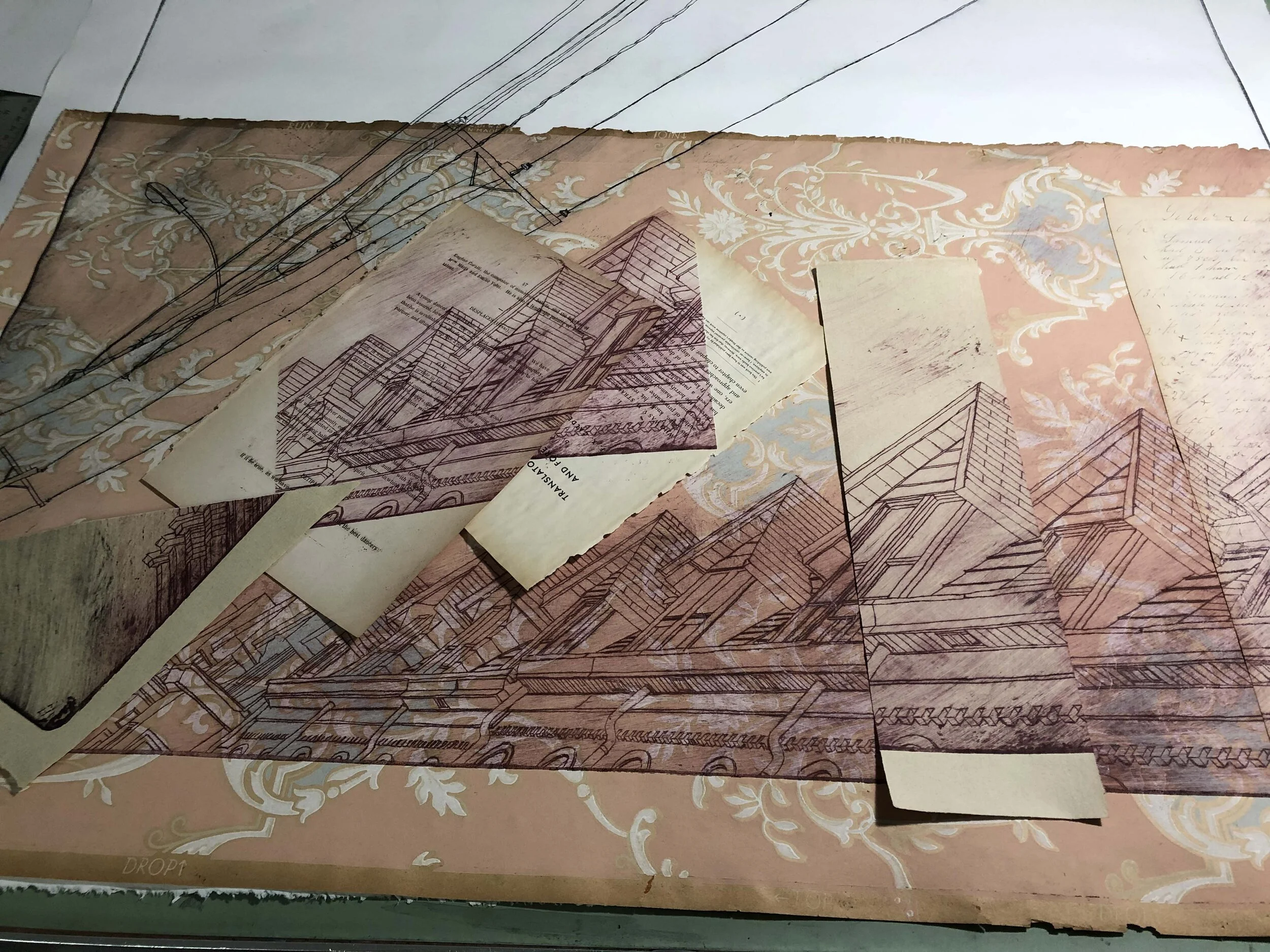
Drypoint collage in progress

Drypoint collage in progress

I did this plate while I was at Remarque. It was a line of rowhouses with power lines running alongside, which I had photographed from an odd angle. I did a number of prints of this plate, among which were a series in deep red ink on cream and pink found papers and wallpaper, and a series in green and black inks on green ledger paper.

Old books, vintage wallpaper, and Goodwill finds are some of my favorite things.

After several months of beneficial rumination, I took out my pieces and composed two versions of the plate. [more to come]

Green Rowhouse in progress smaller.jpg

At the top of this photo you can see a plain print of the plate in black ink on a single sheet of paper. This is my key image, which allows me to fit the collage pieces together on top. That image gets fully covered in the collage process. Then I have a lot of little pieces that have bits of the overall image printed on them, and these will be composed and collaged together.

Once the collage is completed, I go into it with watercolor, acrylic, or colored pencil to bring out features I want to emphasize. In previous ones, everything was covered in clear acrylic so they could be framed without glass, but these I made without the acrylic coating.

The finished pieces in this method are all very unique, and though not as spontaneous as plein air, for me they tell the same story, each one with its own ending. I like that.

Leaning Rowhouses [pink]

Leaning Rowhouses [pink]

See Leaning Rowhouses [green] on its gallery page to learn more.
See Leaning Rowhouses [pink] on its gallery page to learn more.


Saint Ulrich of Augsburg

Saint Ulrich was born around 890, and became the Bishop of Augsburg, Germany. He was the first saint actually canonized by a Pope, John XV, in 993.

Cardboard Icon of St Ulrich of Augsburg

Cardboard Icon of St Ulrich of Augsburg

Ulrich was a really sickly child, so his parents sent him to a monastery for study and so he could die on someone else’s watch. There he adopted a whole foods plant based diet, and his health improved so much that he was able in later life to rebuild churches, feed and minister to the poor, and live on very little sleep.

There is an interesting story about St. Ulrich and a fish. Now Ulrich was not one of those snob vegans, and as such he didn’t mind when others around him ate meat. It seems that he and a friend, St. Conrad of Constance, were walking and talking until well into the night and forgot to eat their picnic supper. [Who forgets to eat? Dude.] Anyway, by the time they remembered, it was past midnight, and they happened to now be on a fast day, which meant no meat, only fish. When they opened up their picnic basket, the meat Ulrich’s friend Conrad had packed had turned to fish, causing them both to exclaim, “Wahoo!” As a result, St. Ulrich is often pictured holding a fish.

On the morning of his passing, [vegans die too, you know], he had ashes laid out on the ground in the shape of a cross, sprinkled with holy water, and he laid down on the cross and died.

Being vegan, Ulrich was clearly malnourished, and as such , he is often called upon in times of dizziness and vertigo. So I depicted a protein deficient Ulrich channelling a 70’s vibe, which we all recognize was a vertiginous time in American history. I added a fish, a cross of ashes on his halo, and a semi psychedelic background with a sprinkling of flower power. Cheers to you, St. Ulrich of Augsburg!