What's New In The Studio - July 19, 2020

Passionflowers and Leaves

Having finished my leaves linocut block, I printed it a bunch of times on a variety of papers. I get these papers in rolls that are discarded from a local manufacturer, and most of them are just white in a variety of weights and finishes, but occasionally they toss out some more interesting textures and colors, so I used a lot of those items along with various papers I have piled around the studio, many of which are probably not archival but I like them anyway.

I also carved and printed a relief plate with three different versions of a passionflower, and printed that up as well. I cut all this stuff out and arranged and rearranged until I go the body shape I wanted for the woman in my next piece. Then I carefully tacked her together with glue and added some stronger pieces to the back to keep her together. I am putting her in a large mandorla which I will construct next.

A Linocut Buffet of Foliage and Body Parts

Soft linoleum block with body parts Natalie Schorr - 2020

Soft linoleum block with body parts
Natalie Schorr - 2020

I am working on some mixed media collage pieces that use mostly elements I have made, as opposed to elements I have found. Not that one is better than another, I guess they just express my current state of thinking more accurately. In doing this, I have gathered together several old relief cut blocks and started creating some new linocuts of body parts and other elements that may be useful over and over.

These body pieces are proving to be very inspirational for me. I picked up this soft cut linoleum block from Dick Blick. It’s fairly thick, so I carved both sides. The opposite side is carved mostly with manicules. I printed them up in an array of colors, and I’ll use them over and over.

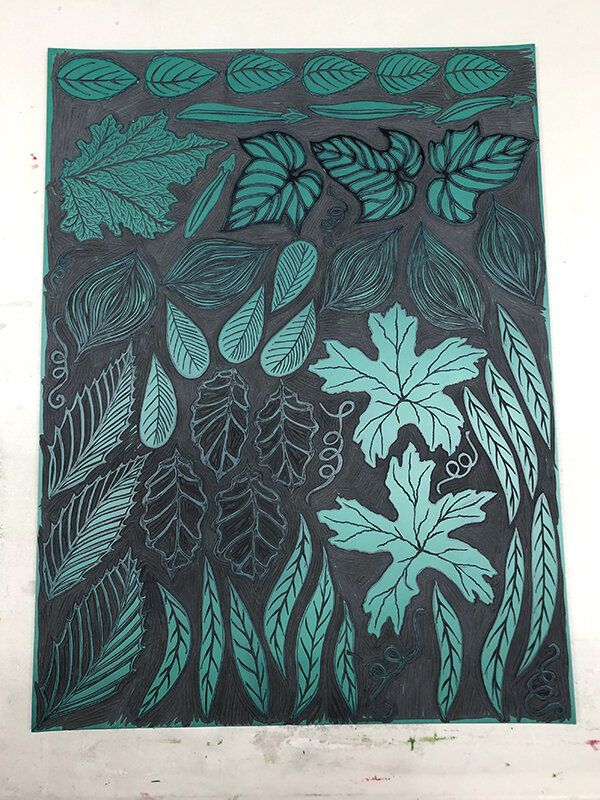
This weekend I also carved up a large lino plate with just leaves. They are another element I can see using a lot, so I drew out a bunch of different shapes. I hope to start printing with these later

Linocut block with leaf shapes Natalie Schorr - 2020

Linocut block with leaf shapes
Natalie Schorr - 2020

I think you will see these leaves and body parts a lot in the coming months.

Telling a Story with Original Prints

I admire my friends who do plein air. They go out and just spontaneously paint. There is very little about a drypoint print that could be considered spontaneous. That being said, it doesn’t have to be a means to a cold, black and white end.

Leaning Rowhouses [green]

Leaning Rowhouses [green]

I did a residency at Remarque New Grounds Print Workshop in Albuquerque in February 2019. I had my drypoint plates already done since they were large and took days to etch, and when I got there I printed like a fiend, which I think drove my whole cohort crazy. Then I shipped everything home and thought about it for several months.

When I first tried my hand at printmaking, I took a little six week class in traditional etching, and we were taught to make multiples that needed to look as much alike as possible. Boring. So in the years since, I have looked for new ways to approach printmaking that would be more flexible. Not quite plein air, but certainly not a series of pieces all just alike.

I like to think of printmaking as a way to tell a story with a different ending each time. Let me show you.

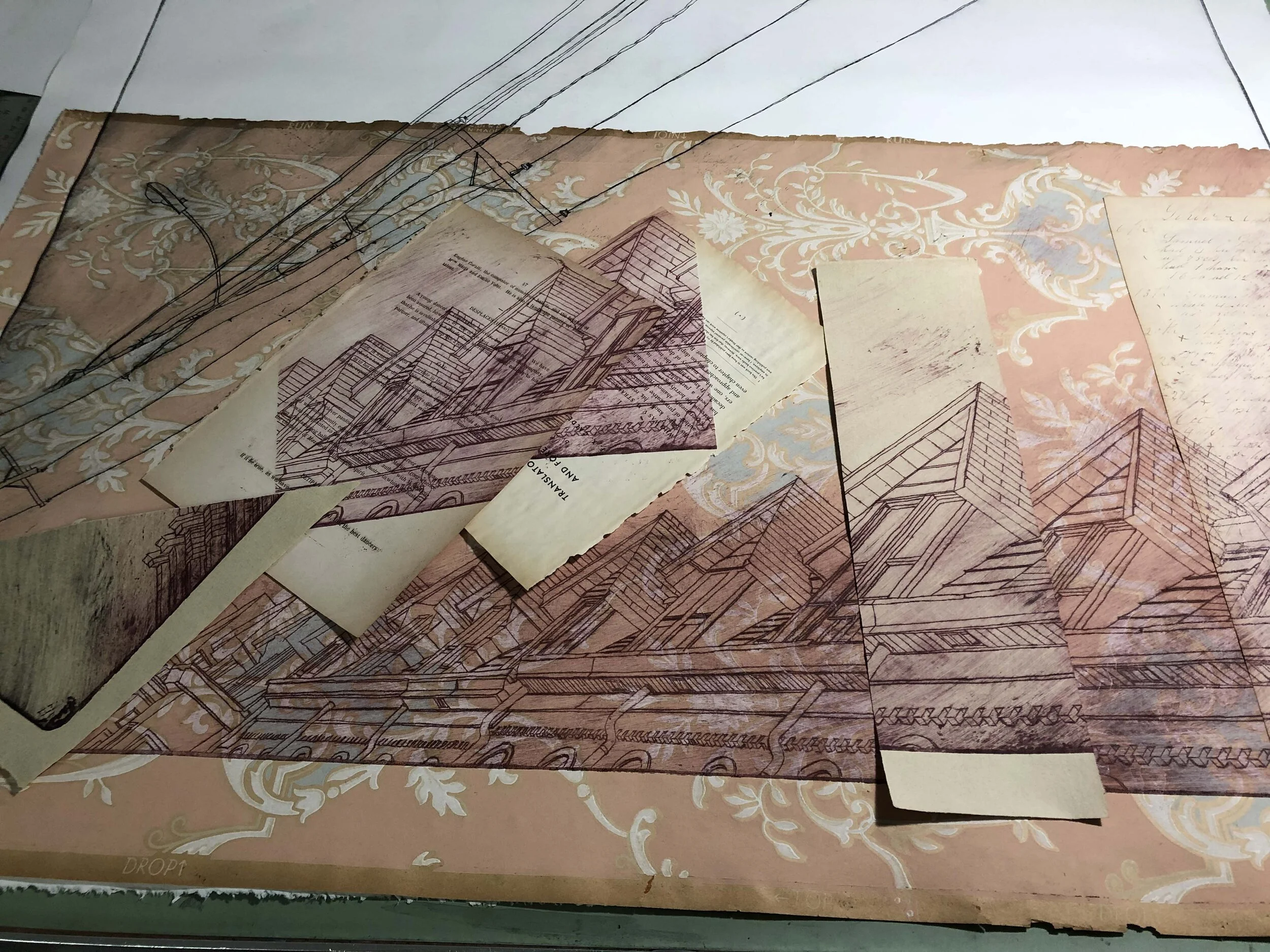
Drypoint collage in progress

Drypoint collage in progress

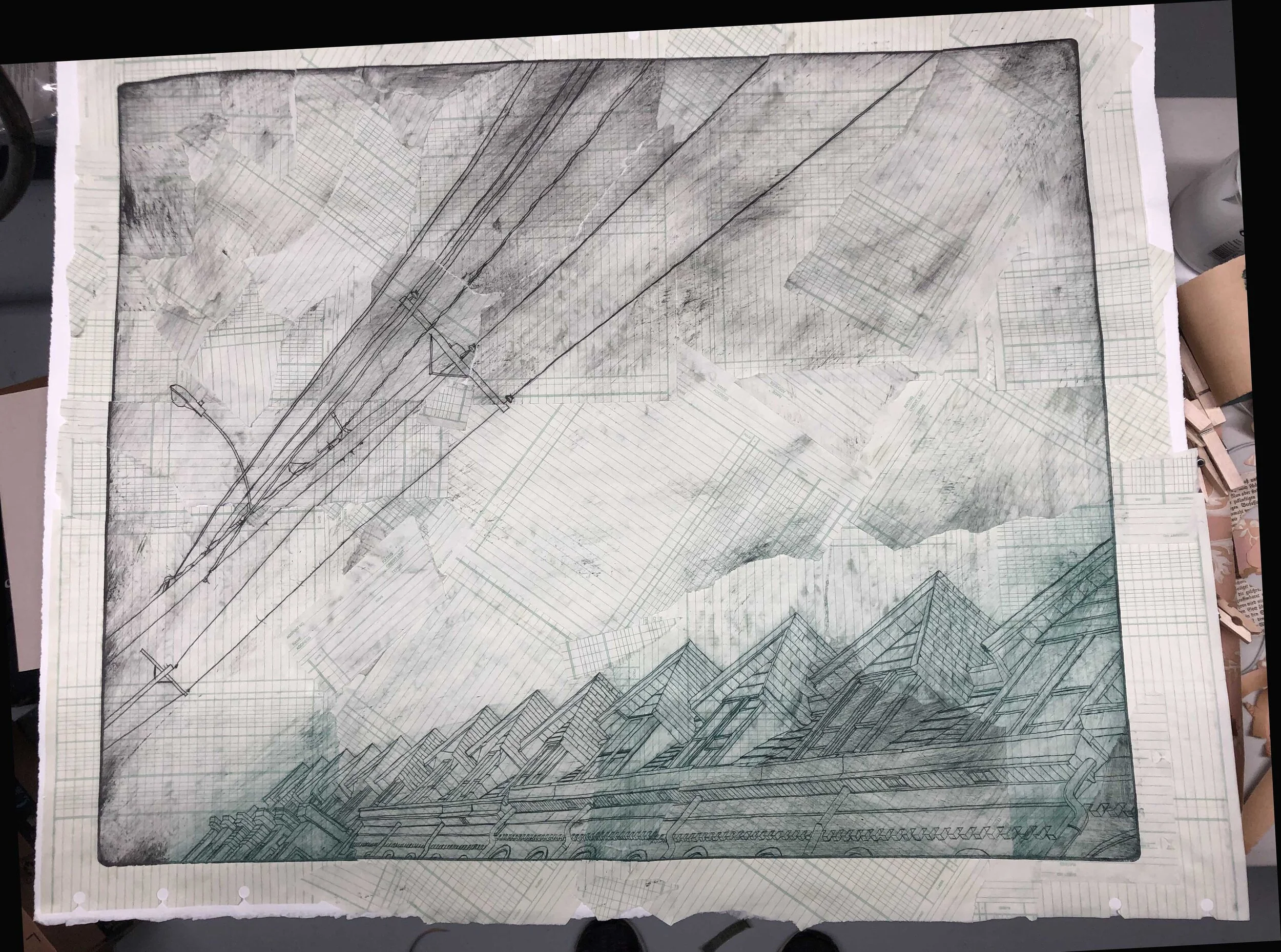
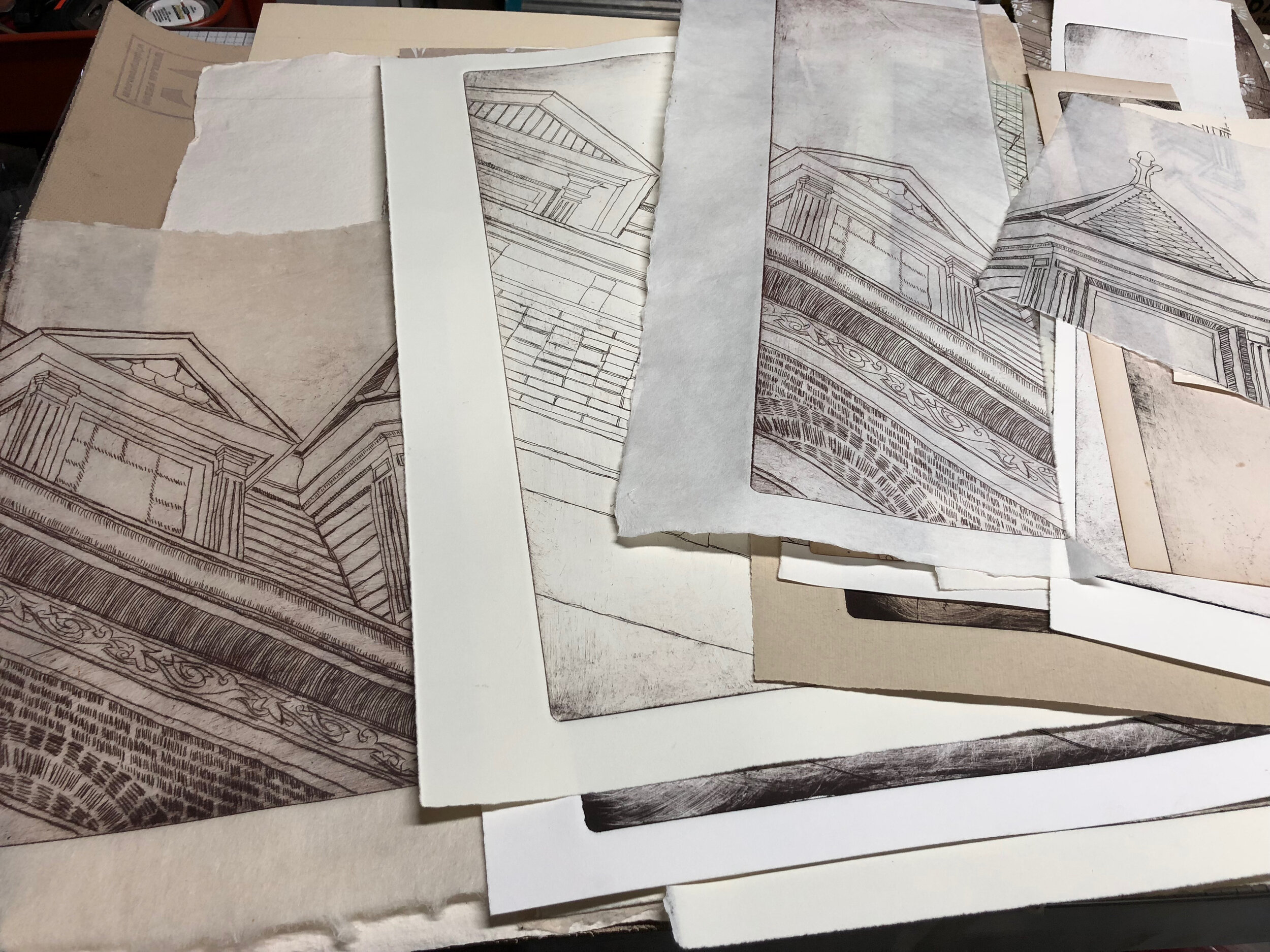
I did this plate while I was at Remarque. It was a line of rowhouses with power lines running alongside, which I had photographed from an odd angle. I did a number of prints of this plate, among which were a series in deep red ink on cream and pink found papers and wallpaper, and a series in green and black inks on green ledger paper.

Old books, vintage wallpaper, and Goodwill finds are some of my favorite things.

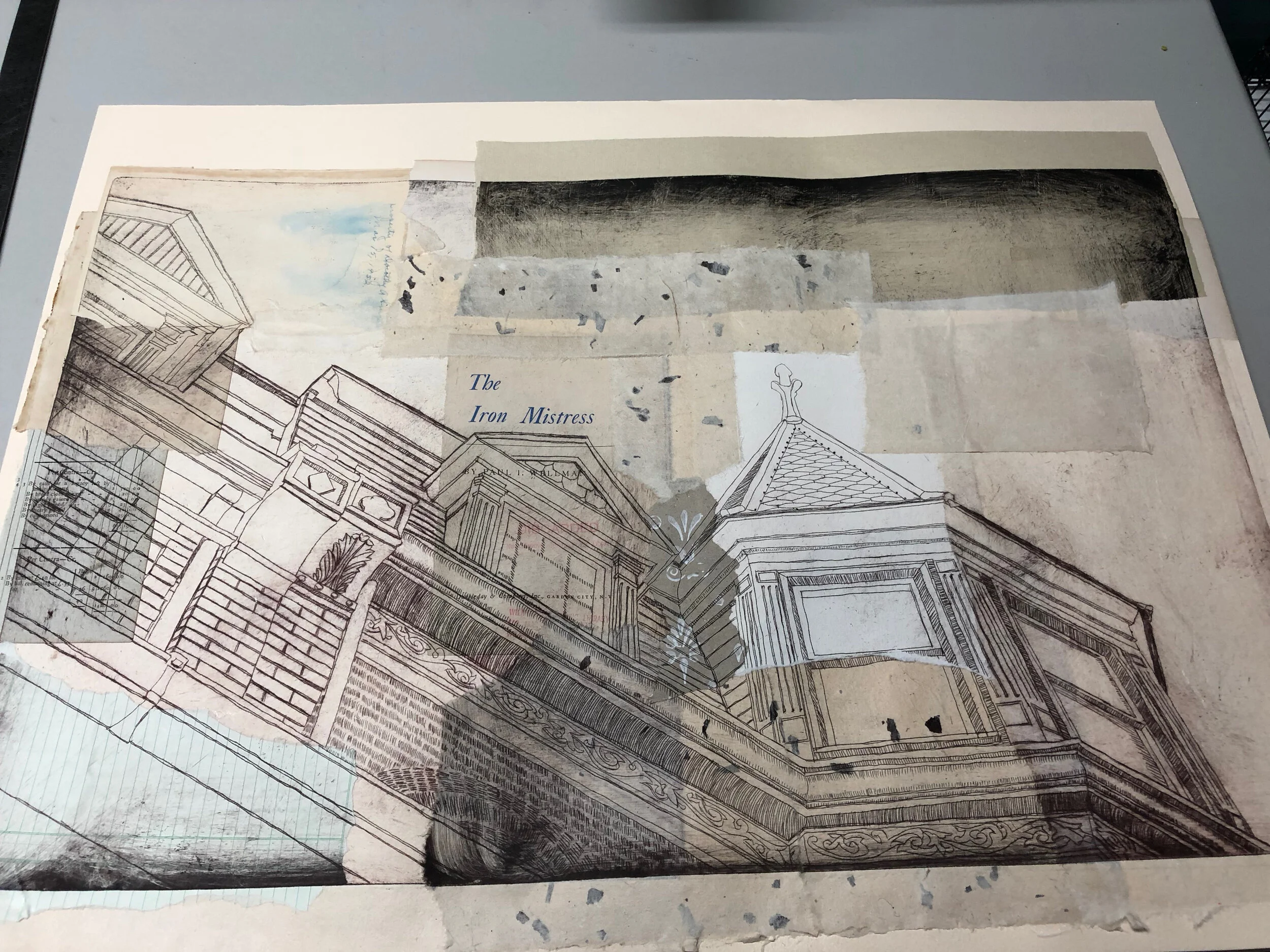
After several months of beneficial rumination, I took out my pieces and composed two versions of the plate. [more to come]

Green Rowhouse in progress smaller.jpg

At the top of this photo you can see a plain print of the plate in black ink on a single sheet of paper. This is my key image, which allows me to fit the collage pieces together on top. That image gets fully covered in the collage process. Then I have a lot of little pieces that have bits of the overall image printed on them, and these will be composed and collaged together.

Once the collage is completed, I go into it with watercolor, acrylic, or colored pencil to bring out features I want to emphasize. In previous ones, everything was covered in clear acrylic so they could be framed without glass, but these I made without the acrylic coating.

The finished pieces in this method are all very unique, and though not as spontaneous as plein air, for me they tell the same story, each one with its own ending. I like that.

Leaning Rowhouses [pink]

Leaning Rowhouses [pink]

See Leaning Rowhouses [green] on its gallery page to learn more.
See Leaning Rowhouses [pink] on its gallery page to learn more.


1000 Origami Paper Cranes

A Project for Dementia

I decided to do a 1000 cranes project for Lent this year. I’ve already given up meat, dairy, and gluten, so I was really running out of things to sacrifice. This just kind of came to me, and I’m glad. It’s been quite a challenge. Why dementia? Let me tell you.

The Backstory

1000 PAPER CRANES

1000 PAPER CRANES

When I was in maybe 6th grade, a friend of mine asked me to be her “campaign manager” while she ran for student council president. It was the very early 1970’s, and we probably looked a lot like Marsha and Jan from the Brady Bunch.

I had gotten an origami kit for Christmas/birthday the previous year, and had learned to fold paper cranes. We decided that instead of doing buttons, [remember, there were no copy machines back then] we would do origami cranes on strings with her name on them. As I remember, we spent the better part of a weekend folding cranes while her mother baked cookies, and we had a lot of fun. No, she didn’t win the election, and I believe she lost to a boy. [Figures.] Some things haven’t changed, although I am thankful that we no longer wear short skirts and knee socks.

Years passed, and we weren’t as close. I doubt I have seen “LydaAnn” since June, 1979, when we graduated from high school. We reconnected via Facebook, albeit not very closely until she began a second Facebook page.

“LydaAnn,” a pseudonym, had started writing a page about life with her husband, who has early onset dementia. She invited me to like her page, now a website, A New Kind of Normal. It’s funny and sad and very, very brave, and I feel such compassion for her and her situation. Please visit her site; I know she would be grateful for the support.

And so I was sitting in a meeting at church the day before Ash Wednesday, thinking about her and her husband and that, some 47 years ago, she had had enough faith in me to ask me to help her student council campaign at a time in my life that was pretty bleak. And I thought about the paper cranes.

The Story of 1000 Origami Cranes

1000 CRANES FROM RECYCLED PAPER

1000 CRANES FROM RECYCLED PAPER

The basic story of 1000 cranes [Senbazuru] follows a Japanese legend that cranes live to be 1000 years old. It is thought that if a cycle of folding 1000 paper cranes is completed within the span of a year, the folder is granted a wish. This also became part of the story of a young girl named Sadako Sasaki, who died at the age of 12 from leukemia, the result of having been extremely close to ground zero in Hiroshima at the dropping of the first atomic bomb. She began folding cranes in the hope of healing. You can read more here.

Hanging mobiles of 1000 paper cranes are often given to people who are very sick, and are hung outside temples in Tokyo and Hiroshima and allowed to slowly dissolve, releasing their wish slowly.
I really connect with that idea.

Getting it Done

I thought about dementia, how it robs a person of years, months, days, words, and memories. The idea that the cranes could be hung outside, and that their words would slowly melt away appealed to me, so I designed the sculpture to be entirely biodegradable. Paper, sticks, and hemp string are the only elements.

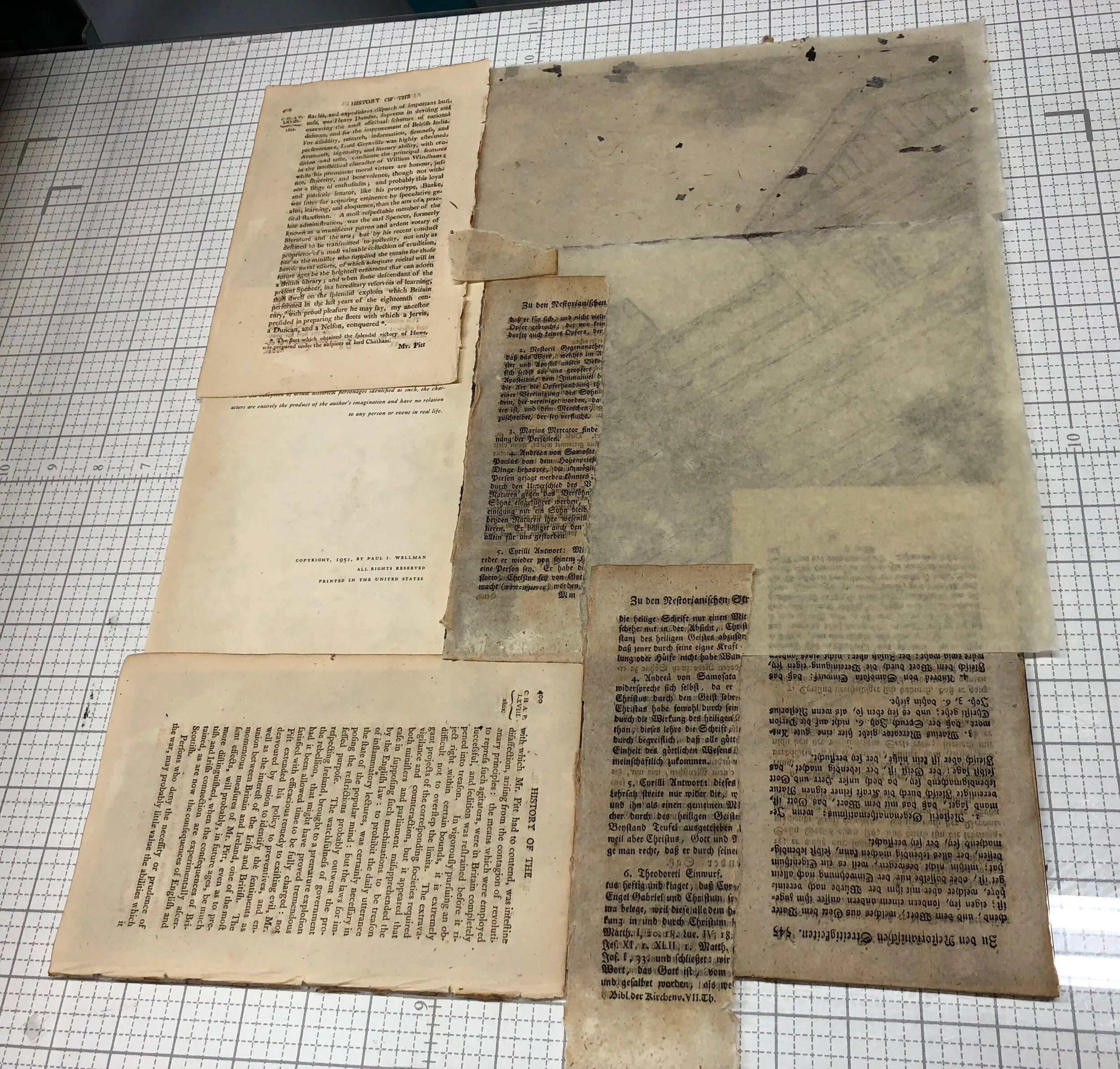
I used a variety of old papers for the cranes. The stuff of today - business reply mail, calendar pages, church bulletins, work presentations. The stuff of yesterday - pages of books and novels and notebooks, old McCalls and Playboy magazines [just the articles, because that’s why your father bought them, right?]. The stuff of history - pages from a German text and an English math book from the late 1700s. All covered with words. I felt like the myriad of papers would dissolve randomly, like memories, when exposed to the elements.

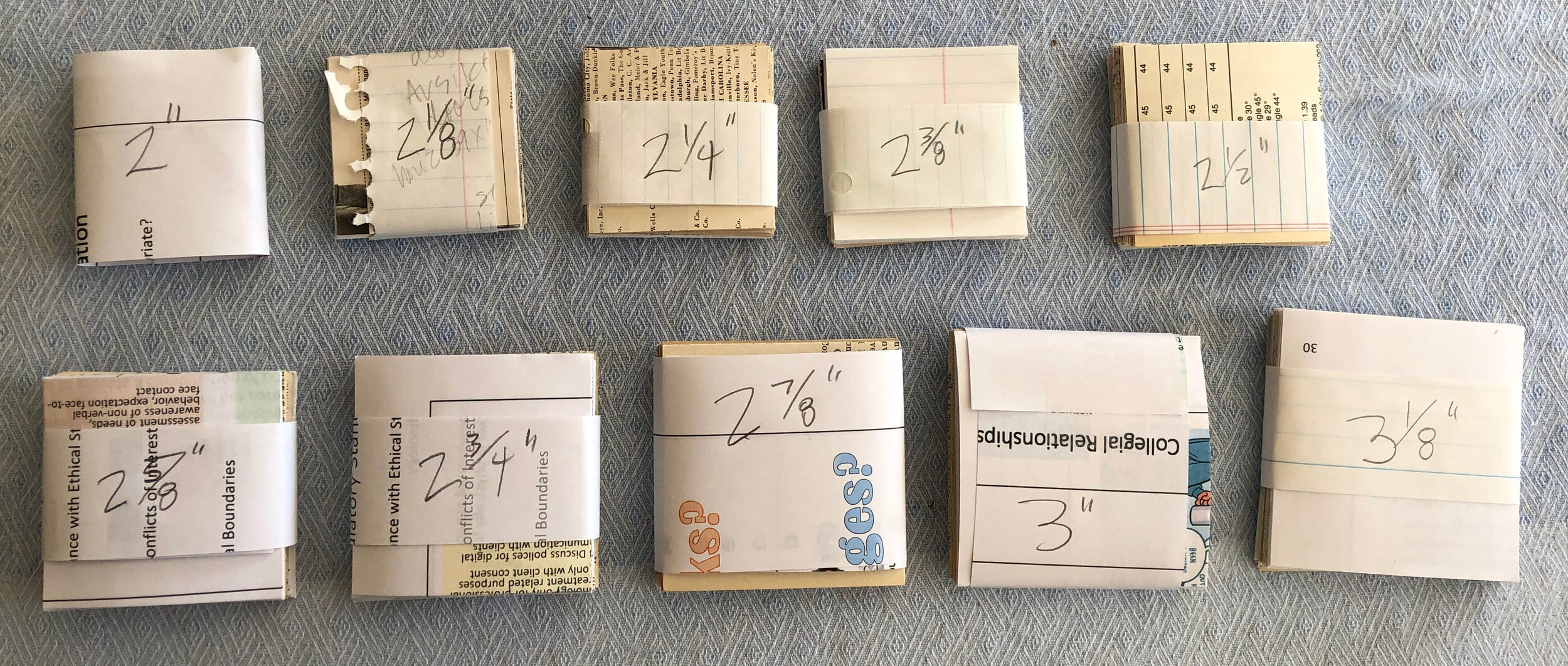
PAPERS, OLD AND NEW, 100 OF EACH SIZE CUT AND STACKED AND READY TO FOLD.

PAPERS, OLD AND NEW, 100 OF EACH SIZE CUT AND STACKED AND READY TO FOLD.

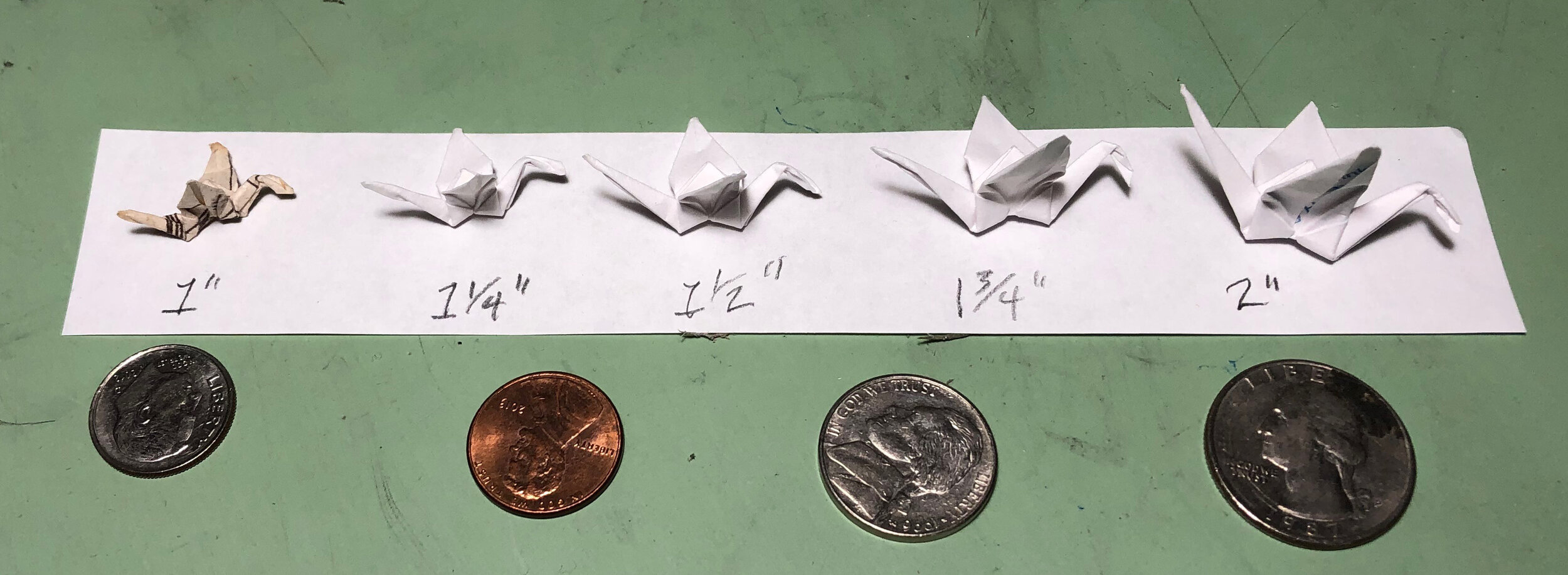
I considered how big to make the paper cranes, and did a little R&D to figure out the minimum realistic size I could fold. I started with a piece of paper 1” square, and started working up from there, concluding that a 2” square piece of paper would be the minimum comfortable size. Then I cut and folded 100 of these, cut and folded 100 at 2 1/8”, 2 1/4” and so forth up to 3 1/8,” making 1000 paper cranes.

R&D on paper size for the smallest practical size crane

R&D on paper size for the smallest practical size crane

I used a large needle and 20 lb. natural hemp cord to string together the cranes, knotting between each crane, and working from small to large on each strand. The 20 lb. hemp was the perfect weight and strength for this sculpture, being tight and willing to hang straight.

Many Blessings

At 3-4 minutes per crane, that’s 50- 66 hours of just folding cranes. It didn’t really occur to me to time it out until I was about 300 cranes in, and just beginning to realize the commitment I had made.

At that point, you enter a certain struggle that requires you to summon forth a great deal of discipline. Add to that the very condensed time frame of Lent, and the number of cranes you need to fold every day is sizable. Persevering through a long, repetitive job, however, has its blessings. I felt a great sense of accomplishment in the end.

Behind empty bench.jpg

And now, I am going to ship a big box with a mobile containing 1000 hand folded paper cranes to a woman with whom I was friends over 40 years ago, who I barely know now. What will she think?

I know I was blessed that she had faith in me when we were kids. I hope she will be blessed in return now that we are older. And the wish I earned by completing the 1000 cranes task, I grant to LydaAnn.

Artist Residency at Remarque New Grounds Print Workshop

I recently spent a week as one of five Artists in Residence at Remarque New Grounds Print Workshop in Albuquerque NM. It was my first time on a residency, and it was an great experience.

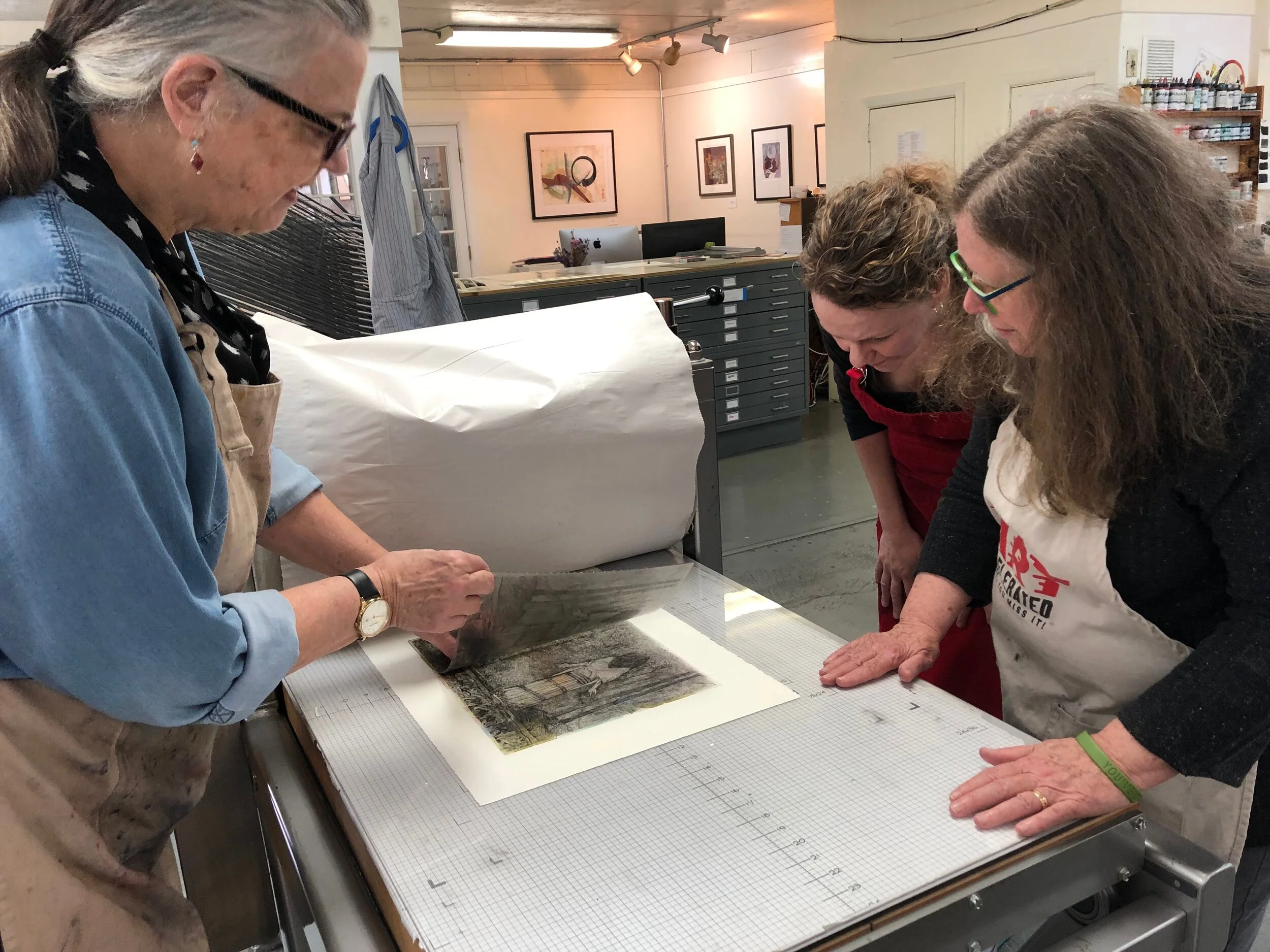
Mary, Jennifer, and Christine collaborating on a print

Mary, Jennifer, and Christine collaborating on a print

The facility at Remarque is really well planned and maintained. Available are numerous Takach presses in a wide variety of sizes. Lots of work tables at standing height and good lighting mean plenty of space for creative opportunities. There are also spaces for airbrushing aquatints, vertical etching tanks, and an exposure unit for solar plates. Additionally, there is a large, open classroom area and two galleries exhibiting an awesome array of printmaking styles.

Two of the owners, Lincoln Draper and Mary Sundstrom, have been available most of the day to answer questions and share techniques. Their generosity with their time and knowledge has been inspiring for all of us, and we’ve had a good time learning from them and each other.

IMG-3183.JPG

The week at Remarque allowed me the opportunity to do some very large prints; much bigger than I could achieve on my press at home. The spacious facility made pulling these prints much easier, as all the things I needed from soaking trays to drying racks were there and readily available. Having a plan for what I wanted to accomplish in place before I got there meant that I was able to get a lot done as well.

It’s been an intense week of work, but very rewarding. I’d recommend taking a tour of the Remarque facilities if you are ever in Albuquerque, and consider taking a class or becoming a member if you live in the Albuquerque area. Never stop learning.

Saint Ulrich of Augsburg

Saint Ulrich was born around 890, and became the Bishop of Augsburg, Germany. He was the first saint actually canonized by a Pope, John XV, in 993.

Cardboard Icon of St Ulrich of Augsburg

Cardboard Icon of St Ulrich of Augsburg

Ulrich was a really sickly child, so his parents sent him to a monastery for study and so he could die on someone else’s watch. There he adopted a whole foods plant based diet, and his health improved so much that he was able in later life to rebuild churches, feed and minister to the poor, and live on very little sleep.

There is an interesting story about St. Ulrich and a fish. Now Ulrich was not one of those snob vegans, and as such he didn’t mind when others around him ate meat. It seems that he and a friend, St. Conrad of Constance, were walking and talking until well into the night and forgot to eat their picnic supper. [Who forgets to eat? Dude.] Anyway, by the time they remembered, it was past midnight, and they happened to now be on a fast day, which meant no meat, only fish. When they opened up their picnic basket, the meat Ulrich’s friend Conrad had packed had turned to fish, causing them both to exclaim, “Wahoo!” As a result, St. Ulrich is often pictured holding a fish.

On the morning of his passing, [vegans die too, you know], he had ashes laid out on the ground in the shape of a cross, sprinkled with holy water, and he laid down on the cross and died.

Being vegan, Ulrich was clearly malnourished, and as such , he is often called upon in times of dizziness and vertigo. So I depicted a protein deficient Ulrich channelling a 70’s vibe, which we all recognize was a vertiginous time in American history. I added a fish, a cross of ashes on his halo, and a semi psychedelic background with a sprinkling of flower power. Cheers to you, St. Ulrich of Augsburg!

Drypoint - Variations on a Classic Printmaking Technique

I love to experiment with printmaking. Never having been very good at following the rules for making an edition, I have the most fun when I stray from the norm, as I did with these collaged drypoint prints.

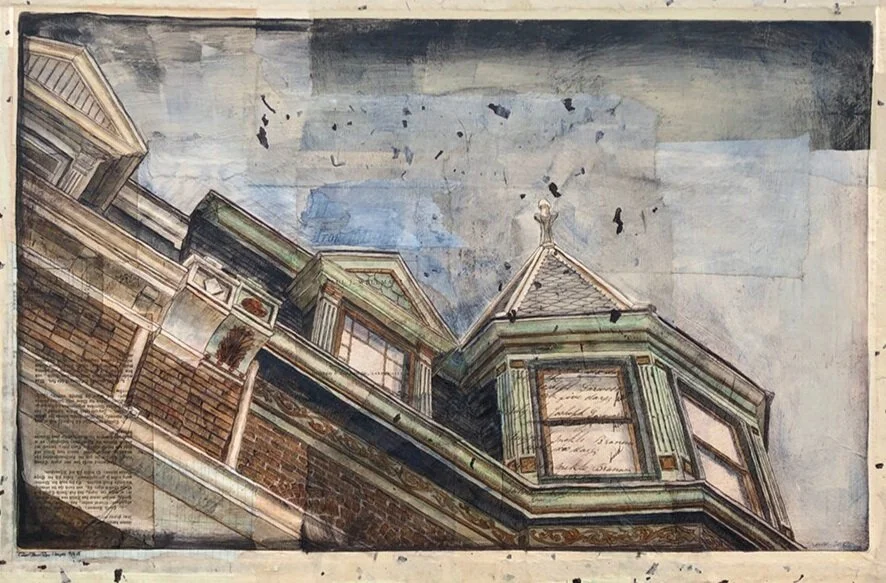
Rust Belt Row Houses 2/4 VE, by Natalie Schorr 2018

Rust Belt Row Houses 2/4 VE, by Natalie Schorr 2018

I wanted to do some printmaking pieces based on photos I took over the summer of some favorite Rust Belt cities. Industrial sites and old row houses are ubiquitous in these areas, and they bring back memories of the years I lived in Pittsburgh. I also wanted to recapture the feeling of a memory, where things are a little fuzzy, pieced together, and imperfect; more the soul of the memory than the accuracy of the reality.

I started with a drawing from a photo, which allowed me to work out the details and make a few edits. The drawing was made to the size I wanted the final piece to be. I chose a fairly extreme upward angle, a sort of child's point of view. Then I got a couple of pieces of clear acrylic, neither of which was large enough to do the entire piece, but each large enough to do more than half the piece.

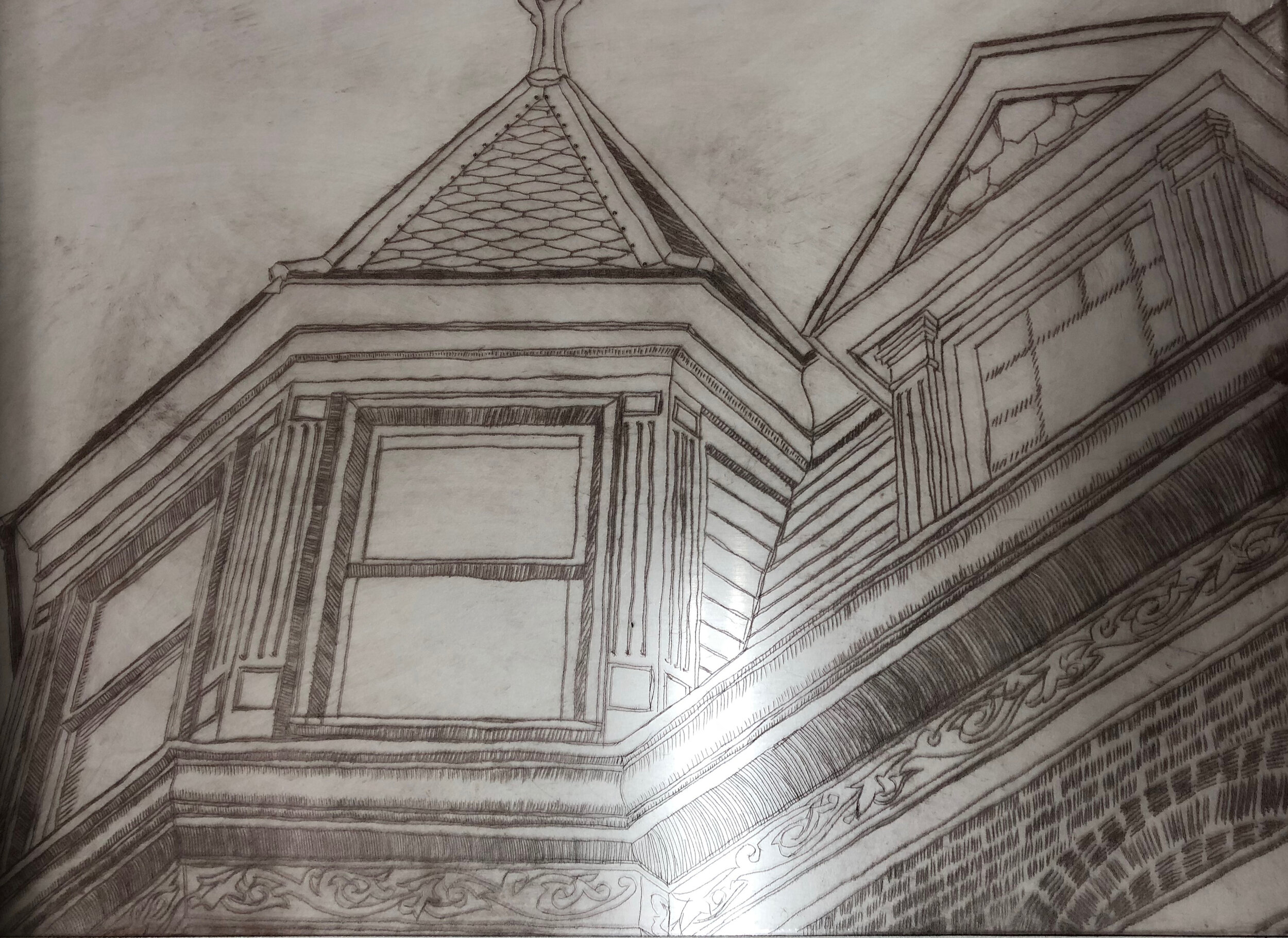
I placed my first clear acrylic sheet over the drawing I had made. Using diamond point and carbide scribes, I simply scratched my image into the surface of the acrylic. No solvents, acids, or hazardous fumes. Just scratching. That's the beauty of drypoint. It's something you can walk away from and come back to anytime, with no worry that you will mess something up. It's really low tech.

Inked acrylic drypoint plate drawn without a straightedge

Inked acrylic drypoint plate drawn without a straightedge

After I finished my first drypoint plate, I put down the second piece of acrylic and did the same. This meant there were areas of the total image that were drawn on both plates; however, they were not exactly the same, just approximately. I also did my drypoint using no straight edges, which meant that lines got pretty wavy, contributing to the memory aspect I wanted to achieve. 

Using acrylic plates for drypoint has both advantages and disadvantages. One advantage of acrylic is that it's transparent, so you can place it right over your drawing, eliminating the need to transfer your image to the plate. Another big advantage to using acrylic is that it's a whole lot cheaper than using a copper or zinc plate. The main disadvantage is that it doesn't really push up much of a burr to catch the ink, so you don't really get the fuzzy line that you get when doing a drypoint in metal. The result is a little cleaner, more like an etching without all the annoying toxic stuff.

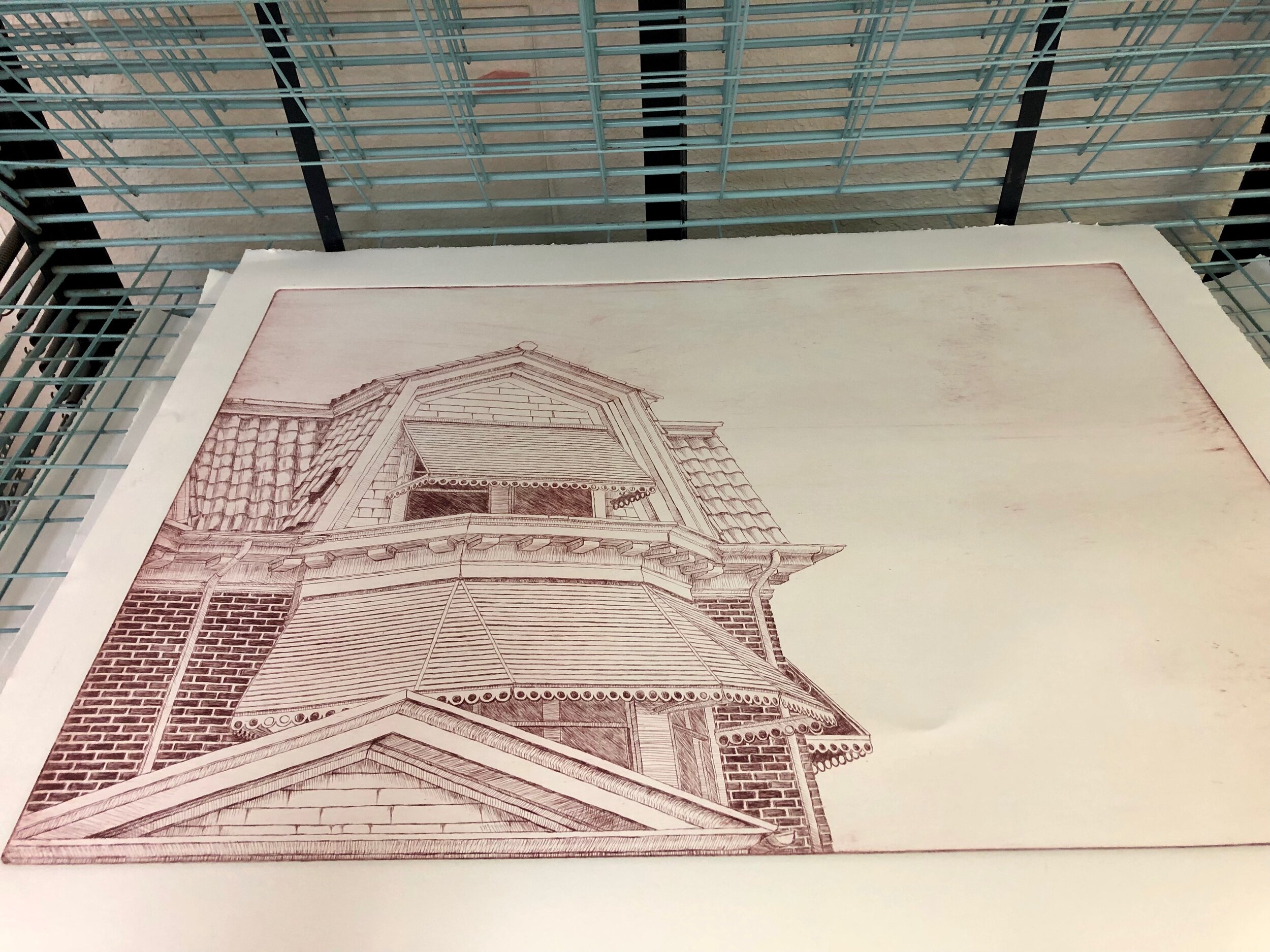
Once I was happy with my plates, I launched into the printing. I used Akua Intaglio Inks, mostly Red Oxide and Carbon Black, with a couple of other colors thrown in. The goal was for the plates to be not inked in the same colors throughout the series, so I just mixed things together somewhat irregularly, but keeping with the sort of rusty brown theme.

Acrylic drypoint plate laid out with scraps of paper and ephemera

Acrylic drypoint plate laid out with scraps of paper and ephemera

I printed each plate multiple times using all sorts of paper scraps. Sometimes I printed the plate on a single sheet, but mostly they were printed on multiple sheets, incorporating pages of old books, vintage wallpaper, and handwritten ephemera into the mix.

Piles of partial drypoint image impressions, ready for collaging

Piles of partial drypoint image impressions, ready for collaging

Once I had a big pile of image pieces, I began the collaging process. It's good to note that you will want to have at least twice the number of printed pieces as you will have finished collages, as you need that many to have enough to compose what you want. So for my 4 finished collages, I actually printed my plates 8-9 times each.

I used a backing sheet and arranged and glued each composition using heavy acrylic medium. Because it has less water, it makes a good adhesive that doesn't swell the fibers in the papers.

Collage showing variations resulting from different papers, ink colors, and plate tone

Collage showing variations resulting from different papers, ink colors, and plate tone

Once the collages were done, I primed each piece with clear acrylic on top, and colored them with thin washes of acrylic paint, being mindful to let the drypoint show through. Each piece was done differently, but kept within the color scheme I liked best from a Pinterest board I made to establish the dominant colors of the area.

Rust Belt Row Houses 2/4 VE
Rust Belt Row Houses 4/4 VE